

Holidays are best when the whole family can get together and enjoy the trip, but what about those members of the family who walk on all fours and are covered with fur?
You may have considered taking your furry bundle of joy away with you on holidays. But have you put much thought into the logistics of travelling with your fluffy companion?
A good deal of preparation and planning is a must whenever you go on holiday, but if you have pets, your to-do list may be that much longer.
If you do take your furry friend away with you, you’ll need to think of a pet-friendly destination and pack all the necessities. On the other hand, you may opt to leave your fluffy family member in the care of someone else. Whatever you decide, you’ll want to ensure that your four-legged friend is in safe hands.
Our ultimate guide tells you all there is to know about travelling with or without pets! You’ll get top holiday pet planning holiday tips, find out which airlines allow pets, an overview of the Australian quarantine rules, and tricks if you’re delayed home, plus much more!
Your fur-friends are part of the family so it’s only natural to have their best interests in mind whilst you holiday. Whether you bring them along or leave them at home, making sure they’re cared for is a must.


1.Organise documentation
There’s a lot of paperwork involved when taking your pets on holiday. Pre-travel you’ll need to organise export and import papers, transit health certificates, IATA shipper’s certificate, permits and quarantine provisions & more!
3 create comfort
Taking Rover or Mittens on a plane? They are most probably travelling by crate. Make their journey comfortable with a few creature comforts. Whilst it’s not recommended to feed your pet too close to the flight, you must keep them comfortable & hydrated.
2. when is best?
Your pets comfort during travel should be top priority. If travelling in summer avoid flights during the middle of the day, and in winter avoid early or late flights in the cold. A bit of encouragement and training pre-travel can put even anxious pets at ease.
4. Get the vets ok
Older pets over 12 years of age or animals that are pregnant must be accompanied with a vet certificate stating the pet is fit-for-flight. Your vet must also provide proof your pooch or feline will not give birth mid-air!
There are strict rules around the transportation of animals by air. Airlines and transport providers along with animal welfare agencies and veterinary practitioners have created guidelines to ensure your pet travels safely and comfortably. Here are a few things that airlines typically will not allow…this will of course vary from airline to airline.
Certain breeds
Many airlines do not allow breeds like the Brazilian Fila, Japanese Tosa, Dogo Argentino, American Pit Bull, American Staffordshire Terrier and Pit Bull Terrier.
Other animals
Any animal other than a dog or cat (such as snakes, rabbits or rodents) will not be permitted onboard or in the hold.
Large
Cages within the hold will have weight and height restrictions e.g. Singapore airlines have a max cage height of 0.56m on flights operated by the A330.
Young animals
Cats and dogs under eight weeks old are usually not allowed to travel.
Pregnant animals
No carriage for pets that have given birth in the last 48 hours before the flight.
Pets travelling separately
Pets may not be allowed to travel as freight in the hold if you are not on-board the same flight.

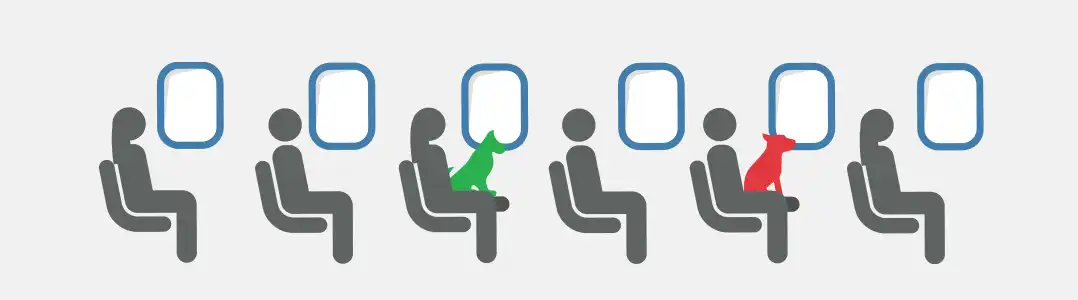
So you’ve decided to take the plunge and take your significant furry other with you on your big trip. Your holiday will certainly get off to a ‘ruff’ start should your pet get turned away at the airport. To avoid barking up the wrong tree, check in advance that your chosen airline will fly pets.
The following is a finite list of Australian serving airlines that will carry pets. Each will have a different set of guidelines and rules for pet travel so be sure to do your homework before you book.
Air New Zealand
Air New Zealand allow domestic pets, cats and dogs, (excluding any transported for profit e.g. racing greyhounds) and small caged birds to travel as checked-in baggage on all domestic services within NZ. For any other type of animal visit their cargo section.
British Airways
British Airways allow registered assistance dogs to travel in the cabin while all other pets must travel in the cargo hold, except OpenSkies flights between Paris and New York where cats or dogs under 6kg/13.2lb are accepted in the cabin.
cathay pacific
Cathay Pacific will not allow pets, other than service dogs to travel within the cabin. All other pets must travel as cargo. Breeds not allowed to travel at all include the Himalayan, Persian or Exoctic cat, or Boxer, Pug, Mastiff and more. The Hong Kong Agriculture, Fisheries and Conservation Department (AFCD) has very strict regulations regarding the import/transhipment of dogs. Dogs cannot be brought into or transit through Hong Kong unless a Special Permit to do so is obtained in advance from AFCD. Additional prior approval from AFCD is also required for in-cabin transport of a Disability Assistance Dog.
etihad
Etihad like most airlines, do not allow you to travel with pets within the cabin either. Guide dogs to lead the blind are permitted however, for flights from Abu Dhabi to USA and vice versa only. Typical breed restrictions apply. They do accept the carriage of falcons in the main aircraft cabin provided that all the necessary documents have been obtained. All other pets are accepted only as manifested cargo and are not permitted within the aircraft cabin or checked baggage.
Jetstar
Jetstar do not allow pets to travel within their cabin. If you wish to travel with your pets you can arrange to do so with Qantas freight, or with Jetpets.
Qantas
Qantas also require pets to travel as freight. You can visit their website for more information. They allow Dogs (excluding racing greyhounds), cats, rabbits, guinea pigs, domestic fish (with no aeration requirements and that are not intended for resale), and domestic birds (maximum 4 birds per cage, that do not need a permit), to travel. They do not allow any animal classed as a dangerous dog (including pit bull terriers, Japanese Tosa and Brazilian Fila) on any of their aircraft. Just like us, your pet should be fit, healthy and able to cope with being confined for an extended period.
Singapore airlines
Singapore Airlines allow cats and dogs to travel on the same flight as you in the air-conditioned cargo hold underneath the passenger cabin. Carriage of pets in the aircraft cabin is not permitted, with the exception of service dogs.
Virgin Atlantic
Virgin Atlantic only allow pets to travel within the hold. The animal must be held in a container compliant with the airline’s guidelines. The pet can’t be a snub or pug nose breeds like Pekingese or Persians, or any dog listed under the Dangerous Dogs Act. Don’t forget their Flying Paws scheme - this means your furry friends can now earn Flying Club miles!
Virgin Australia
Virgin Australia will only take pets who travel as cargo, not within the cabin. They also will only take non-aggressive, healthy animals, over 8 weeks old that follow all quarantine rules. A maximum of 2 cages per flight is permitted. Certain breeds such as Bulldogs are restricted. If travelling into Tasmania, your dog must be treated for the Hydatids Tapeworm prior to arrival. You can even earn frequent flyer points when travelling with pets with their Velocity Frequent Flyer Programme or with their partners jetpets.
OH Hygiene, its time to consider quarantine!
So if you didn’t already know by this point, taking your pet overseas is a BIG deal! When your cat or dog is exported from Australia it immediately loses its Australian health status. This means you might not be able to bring it back to Australia at short notice.
Agriculture.gov.au states that cats and dogs can only return to Australia from “approved countries” and, depending on the country, the pre-import preparation time, or time spent in quarantine, can be over six months. However, if you start preparations in Australia before you and your pet head overseas, returning them to Australia can be much simpler and quicker So what does “approved countries” actually mean? Basically cats and dogs may only leave and come back into Australia from “approved” countries such as New Zealand, the Cocos Islands and Norfolk Island.
All testing and treatments must be performed by a Government Approved or Official Government Veterinarian in an approved country. If there is any chance that you may wish to return to Australia with your dog or cat, they recommend that they have a rabies vaccination and Rabies Neutralising Antibody Titre (RNAT) test performed prior to leaving Australia. If you are likely to return your dog or cat to Australia within six months of departure, they recommend that you apply for, and hold, a valid Australian import permit prior to departure from Australia so that you are aware of the re-entry requirements specific to your pet.
On the other hand, there are many countries that pups and cats cannot be brought from into Australia at all. These are referred to as ‘non-approved’ countries.
Non-approved countries include:
American Samoa, Bahrain, Barbados, Christmas Island, Cook Island, Falkland Islands, Federated States of Micronesia, Fiji, French Polynesia, Guam, Hawaii, Iceland, Japan, Kiribati Mauritius, Nauru, New Caledonia, Niue, Palau, Papua New Guinea, Samoa, Singapore, Solomon Islands, Kingdom of Tonga, Tuvalu, Vanuatu, Wallis and Futuna, South America, Central America, Carribean, Europe, Africa, South Africa, Middle East, Canada, Asia.
Head to Department of Agriculture, Fisheries and Forestry: Cats and dogs returning to Australia for more information.
It’s time to paws for thought…
So you’ve decided that you can’t be without your four-legged friend, but have you considered whether your pet insurance is valid when you’re away from home on holiday?
Just like you wouldn’t confuse little Fido for a feline, you shouldn’t take your pets away without the correct cover. So will your policy cover your cat or cavoodle for an overseas trip?
Lucky for you, insurers such as 1300 insurance, Bupa, Medibank, Pet Insurance Australia, Real Insurance, Petplan, Prosure, RSCPA and Woolworths will pay for pet expenses incurred for the treatment of your pet whilst they are “overseas”.
However as mentioned before, the definition of “overseas” is fairly limited. You will not be insured for any destinations where Australian quarantine regulations require your pet to be quarantined on its return. This brings the list of overseas destinations to just the Cocos Islands, New Zealand and Norfolk Island. Policy restrictions also apply:
-
You may not be covered for emergency repatriation costs to return your pet home if they are sick or injured overseas
-
You cannot go on long trips: most policies will restrict the length of time you can take your pet out of the country for - usually no more than 60 days.
-
You may not be able to claim for an incident that happened when your pet was not under direct care. If you go overseas without your pet, you should nominate an authorised person to look after your pet who can also speak to your insurer in case anything were to happen
Just like your travel insurance, pet insurance benefits and exclusions vary dramatically so it’s a good idea to read the small print thoroughly to understand when you’re covered.
Delayed home from your holiday, no worry!
There are strict rules around the transportation of animals by air. Airlines and transport providers along with animal welfare agencies and veterinary practitioners have created guidelines to ensure your pet travels safely and comfortably. Here are a few things that airlines typically will not allow…this will of course vary from airline to airline.
Certain breeds
Many airlines do not allow breeds like the Brazilian Fila, Japanese Tosa, Dogo Argentino, American Pit Bull, American Staffordshire Terrier and Pit Bull Terrier.
Other animals
Any animal other than a dog or cat (such as snakes, rabbits or rodents) will not be permitted onboard or in the hold.
Large
Cages within the hold will have weight and height restrictions e.g. Singapore airlines have a max cage height of 0.56m on flights operated by the A330.
Young animals
Cats and dogs under eight weeks old are usually not allowed to travel.
Pregnant animals
No carriage for pets that have given birth in the last 48 hours before the flight.
Pets travelling separately
Pets may not be allowed to travel as freight in the hold if you are not on-board the same flight.

If you do decide to leave your pets at home, you need to take steps to ensure that your animals are safe, healthy and happy while you’re away. Here are some top tips for holidays without your beloved pets:
1. Get a check-up
The last thing you want is a health scare while you are trying to enjoy your holiday. So be sure that your pets’ health and fitness is in good condition before you leave. Arrange a check-up with your veterinarian before you head off. It’s also a good idea to be stocked up with necessary medications your pet needs.
3. Do a trial run
If you’re leaving your pets at home for the first time, there are ways to lessen any potential separation anxiety. You may want to do a short trial run at a cattery/ kennel or at a relative’s home. Just to make sure that your cat or canine is relaxed and comfortable when it’s time to say bye.
2. Sort out accommodation early
Unless you can leave your pets with a friend or family member, you will need to arrange accommodation with a cattery or boarding kennel. The best boarding facilities get booked up well in advance, particularly during peak times like the Christmas or during school holidays.
4. Skip the long goodbye
Resist the urge to drag out saying goodbye. If you and the kids fawn all over your pet, hugging and kissing them they’ll think you’re never coming back! Can’t be without them? You could always install a doggy or kitty cam to keep check on them while you’re overseas.